This follow-on from Part 1 focusses on how you can move from the drama triangle, where everyone loses, to the empowerment triangle, where everyone wins. Not an easy journey, but a worthwhile one.
This post follows on from Drama Llama Karma - Part 1, so if you haven't read it yet, give it a read and then pop back here 👍
In part 1 I introduced you to the Karpman Drama Triangle, or would it be better to say that I reacquainted you with it ? Though you may or may not have heard the term before, you would have been familiar with the three parts you can play on it as you have probably played all three parts many times in your life. That's why the drama triangle is so entrenched in the way we live. We know how to play the parts so well. They are old, familiar friends. We can slip into character so easily and move around the triangle seamlessly, like professional dancers. It would be a stretch to say that the parts are comfortable to us, particularly if that part is The Victim, but they are familiar and sometimes familiarity and the certainty it brings is enough.
One of the examples I used in part 1 was about denying my Sis the right to watch Crossroads in colour. I was probably 5 years old at the time and had no concept of psychology and drama triangles. But I had learnt how to influence (manipulate) people in the way a 5 year-old does, slipping seamlessly between persecutor and victim as needed to get the outcome I wanted. As I matured I added rescuer to the repertoire when required and probably made that my default until I became aware of the limitations of it. I'd fallen into the trap of thinking that rescuing was kind and noble and helpful. I was almost in my 40's when I realised that there was a better way.
Playing your part
The downside of becoming aware of all this stuff is that, once you are, it's hard to ignore. You'll see people who you love and care about playing the victim, or rescuer or persecutor to get their way. And if it doesn't work they will switch parts to see if that works. But there is a super-important thing to know about the drama triangle:
You can only stay on the drama triangle if both parties play their part !
So the simplest way to move your relationship off the drama triangle is to notice the part the other person is playing and the part they are expecting you to play and.... just not play your part ! So for example:
If someone is playing the victim in the hope they can get you to do something for them (Oh you know I'm rubbish at this, please help me....) - don't be the rescuer;
If someone is playing the persecutor in an attempt to control you - don't play the victim;
If someone is playing the victim in the hope that you will be the persecutor so that they can persecute you (or get someone to rescue them) - don't fall for it.
Being on the drama triangle depends on both of you playing your part, so it should be an extremely fragile construct. But it's not, because we are all masters of all the parts, so we just slip into character and keep the drama going.
☠️ Health warning ☠️
There is a big downside to not playing the part expected of you. It can be very uncomfortable for both parties, particularly with close friends, family and work colleagues. There will be a backlash from the other person and it can be severe as they thrash between parts trying to tempt you back onto the triangle. For example stopping a rescuer from rescuing you is likely to hurt them (victim) which will turn to anger (persecutor) which will make them hate themselves (back to victim) which will be your fault (back to persecutor) before revisiting rescuer again in the hope that you move to victim and everything is as they want it to be. All that can happen in under a minute because we are so good at it and if they are persistent it takes a lot of effort from you to resist being dragged back in !
Not playing your part can range from uncomfortable through to excruciating and can impact on the relationship. But it might be the pattern interrupt you need that will allow you to rebuild a better relationship. That's where The Empowerment Triangle comes in.
Goodbye drama, hello empowerment
As I mentioned in part 1, there is a better triangle to live on when it comes to relationships. The empowerment triangle is an evolution of the Karpman Drama Triangle that seems to have been developed from two sources:
I haven't read either yet but have copies of both on my trusty Kindle to consume. The proper label for this is TED (The Empowerment Dynamic) but I'll stick with empowerment triangle for the purposes of this blog.
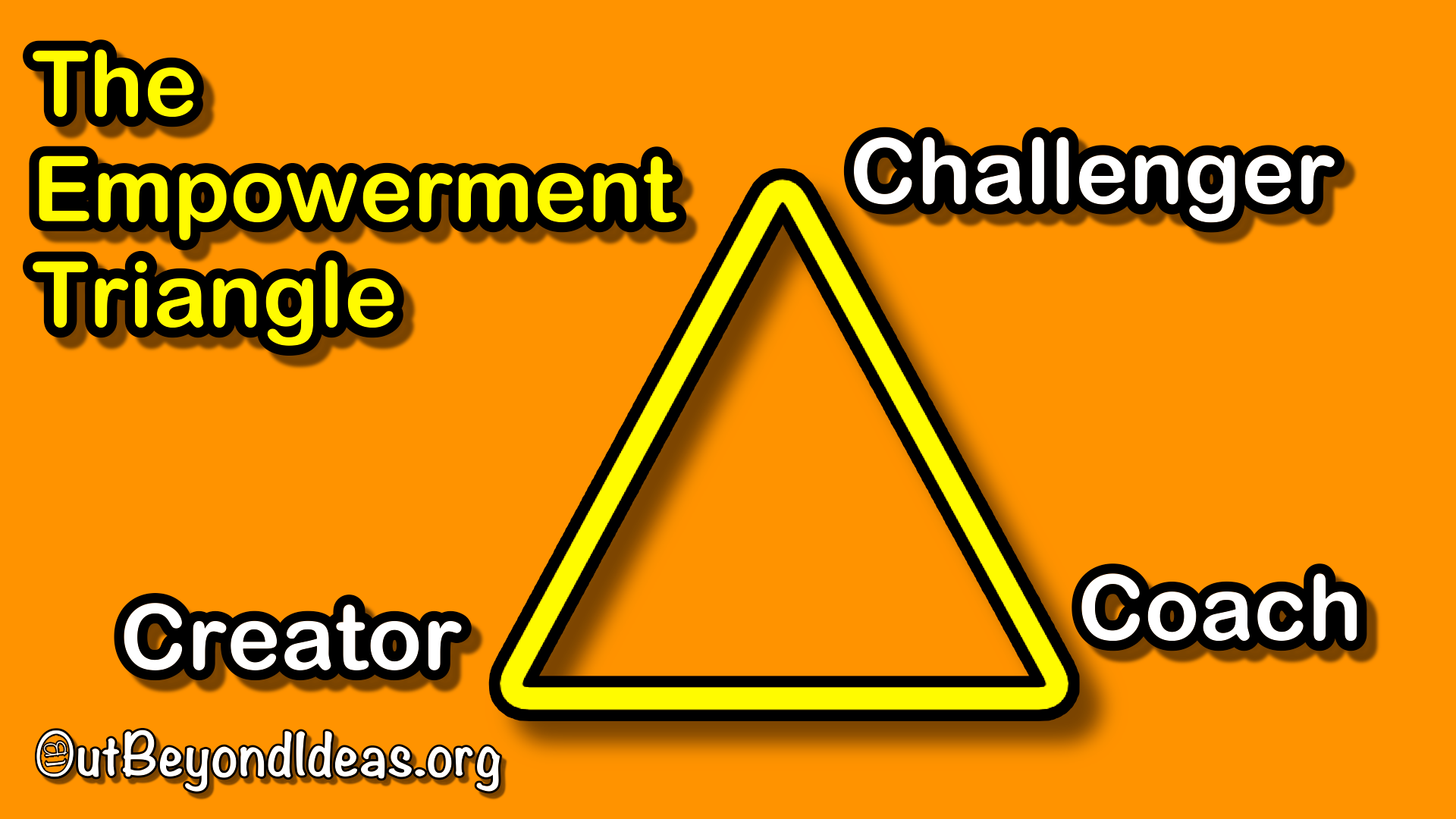
The Empowerment Triangle
A few key things to remember about the empowerment triangle are:
✅
It mirrors the drama triangle, offering alternative parts for you to play: ⭕ Challenger replaces Persecutor; ⭕ Coach replaces Rescuer; ⭕ Creator replaces Victim.
✅
All three parts on the empowerment triangle are positive to play and empower both parties. Everyone in the relationship is a winner and all relationships on the empowerment triangle are healthy.
✅
The equivalent parts on the two triangles are interchangeable and help you move the relationship from drama to empowerment. For example if the other party is playing the victim in the hope that you will rescue them, you can instead play the part of the coach.
So let's look at how the equivalent parts on the two triangles compare.
Rescuer to Coach
I've started with this one as it's probably the easiest transition. Most rescuers don't do it with the intention of keeping the victim in victim mode (at least not consciously). Their desire to genuinely help others just overlooks helping the other person build their own capability. It's that simple shift from doing something for them to teaching them how to do it. From telling them what the problem is to getting them to work it out through inquiry and curiosity. It's about finding out what they really want and empowering them to get it.
In the example of Alice and Debbie, Alice the coach would have worked with Debbie so that she would have had the confidence and capability to challenge Bob herself and the skills to effectively manage a difficult manager. She would have also coached her about finding a new manager as Bob isn't really fixable.
Persecutor to Challenger
This shift is a little bit harder. It firstly assumes that the perscutor had a positive intent in acting the way they did. It's about moving from blaming to enabling. In the Bob and Debbie example, Bob would have welcomed Debbie's questions and praised her for it. If the outcome still hadn't been quite right Bob the challenger would have looked at the positives and then looked at how Debbie could have done even better next time.
Unfortunately Bob would never become a challenger because he enjoys being a persecutor too much.
Victim to Creator
This is probably the biggest leap, especially if the person has felt like a victim for a long time. It takes a significant shift of thinking as outlined in many of the other posts on this blog. To become a creator you need to shift to an attitude of realistic optimism. Blame goes out the window and personal responsibility replaces it. Your focus shifts from where you are to where you want to be.
If you are surrounded by coaches and challengers, you have a better chance to move from victim to creator, but it feels like the hardest shift of the three. In Debbie's case, she'll find it hard to make the move as long as she's working for Bob, however much great coaching Alice gives her. Sometimes, if you can't change the people you just have to change the people.
Summing it all up
I'm not a fan of generalisms, but I'm going to offer you one now:
We are all masters when it comes to relationships on the drama triangle
The problem with being masters of the drama triangle is that it makes us all unconsciously brilliant at it. Our responses to drama triangle prompts are instant, well rehearsed - almost pavlovian ! It's like breathing to us. And that makes it hard for us to step off and respond differently.
It will take time and effort to unlearn something that you do so well, but it will be worth it. The four key steps are:
1️⃣
Acknowledge that you are on the drama triangle.
2️⃣
Recognise the patterns. Move from unconscious mastery to conscious awareness of your mastery.
3️⃣
Identify the part you are playing. Is it just one or are you moving between roles ? Understand each as well as you can.
4️⃣
Change your response. It can be as simple as not playing the part that you are expected to play. But as you develop more awareness, you can move to playing the equivalent part on the empowerment triangle.
Step 4️⃣ is the hardest because it will impact on the relationship when you don't respond as expected. Playing the equivalent role on the empowerment triangle will have less of an impact, but it will still have an impact. There is no easy way. Think about it. If you've been someone's rescuer for a while, becoming their coach is a positive move for both parties, but they will have to make more effort to build the capabilities that you were fulfilling. Some push-back and possible tantrums should be expected.
Imagine.....
We live in a capitalist society which depends on us spending the money we earn so that billionaires can become trillionaires. The world doesn't want you to be happy and contented because, if you are, you won't spend as much. So drama is here to stay, the soap storylines will get darker and more dangerous, the reality TV will get more outrageous, the clickbait will get juicier and many people will continue to take the bait.
But imagine, for a moment, what life would be like if you and your family stepped off the drama triangle and onto the empowerment triangle. Relationships would flourish, happiness and contentment would ripple out from you and infect the people you are close to. You might not change the world, but you would certainly transform your world and the worlds of those close to you. The drama would still be ever present around you and maybe you'll still watch some of it, enjoying it for the fiction it is whilst expressing gratitude that you stopped playing that game some time ago.
That's what living your best life is all about. That's what we mean when we talk about being a 2%er. That's what Out Beyond Ideas is all about. It's where the karma we generate is welcomed with open arms and gives you a big warm cwtch 🤗
Passionate about creating a bit of joy & laughter in this bonkers world and helping others do the same.
International trainer, author, coach & mentor, business change consultant.
Family man, friend, average guitarist, retired civil servant and geek